Behringer CRAVE Review UK 2026
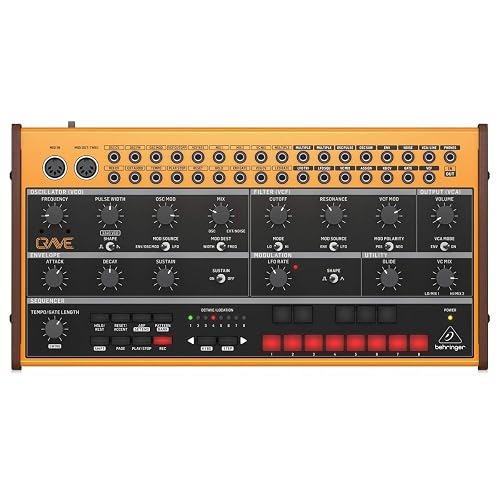
Quick verdict
Score: 8.7/10
Best for: Hands-on sound design and making basslines, leads and pads, standalone
Not for: Anyone wanting a workstation, a stage piano, or a software-only setup
Bottom line: A characterful synthesizer (analog, monophonic, desktop / module) for hands-on synthesis.
Overall, the Behringer CRAVE is a compact analog, monophonic semi-modular desktop synthesizer that uses a 3340 VCO, a ladder filter, and a 32-step sequencer. It is best viewed as a focused The Behringer synthesizer for quick sound creation and simple sequence building. Its direct semi-modular control, ladder filter tone shaping, and 32-step sequencer support repeatable phrases, while monophonic operation limits layered parts.
Key specifications
| Spec | Value Status |
|---|---|
| Voice | Monophonic Specified |
| VCO | 3340 Specified |
| Filter | Ladder Specified |
| Sequencer | 32-step Specified |
Pros
- Analog synthesis
- Monophonic
- 0 oscillators
- Built-in sequencer
- Hands-on, standalone sound design - no computer needed
Cons
- Monophonic - one note at a time, no chords
- No built-in keys - needs a MIDI controller to play
- It's a synth for sound design, not a stage piano or arranger
Sound and Synthesis
The synthesizer shapes sound using analog, monophonic subtractive-style signal flow. A 3340 VCO provides the tone source, while a ladder filter sculpts how bright or dull that tone becomes. The process begins with a single raw pitch and removes frequencies to form the final timbre. Because it is monophonic, the output is focused on one note at a time, making it well suited to basslines and leads. When driven hard, the ladder filter can add extra character, although subtle patches can be harder to keep consistent.
Playability and Controls
With its monophonic desktop/module format, the Behringer is built for hands-on control. It prioritises direct access to sound-shaping parameters so the performer can respond to timing in real time, rather than working only from a pattern-based workflow. As a monophonic synth, it plays one note at a time, so chords need external layering or repeated note triggering. The physical controls support quick experimentation during performance, while users who prefer menu-driven editing or deeper automation workflows may need to spend more time on the panel. A 32-step sequencer is included for extended riffs, but real-time changes depend on keeping attention on the front panel while the sequence runs.
Connectivity and Sequencing
Hands-on sound shaping on the front panel sets the tone for how the CRAVE connects with other gear, and how its built-in pattern tools are used in practice. With the CRAVE's analog signal path, the user typically routes notes and control to external devices, then returns audio to monitors. Its built-in 32-step sequencer supports pattern programming, where the player sets steps, then plays and edits while the sequence runs. Poly chaining is mentioned, so limited multi-voice expansion is expected. Overall, sequencing remains immediate, while the depth of connectivity beyond the general routing is unclear because the specific I/O options are not stated.
Form Factor and Build
Form factor matters for the synthesizer because it is a desktop module-style analog synthesizer with a monophonic voice, and that shapes how it is positioned on a desk or in a rack setup. Its compact layout is aimed at hands-on operation, keeping patching and control within easy reach. The semi-modular wiring can occupy space on the workspace, so cable management remains important when integrating it with other gear. For studio use, it works best when placed so that the 3340 VCO and ladder filter are comfortably accessible during performance and sound shaping.
Who Is This Synthesizer For?
This desktop, monophonic analog semi-modular synthesizer is best suited to setups where short, hands-on sound experiments are the focus, because the panel design encourages frequent tweaking through patching. It suits musicians who want immediate sequence-led riffs, as it includes a 32-step sequencer. The instrument also fits players drawn to classic subtractive workflows, since it pairs a 3340 VCO with a ladder filter that is central to tone shaping. Beginners may find it approachable for straightforward melodies, but musicians needing complex polyphony, or fully automated control beyond what the included sequencer and controls provide, will need alternatives.
Where to Buy in the UK
Finding this synthesizer in the UK is typically straightforward via major music retailers and well-known online shops, particularly around release-cycle stock movements. Buyers can check listings at Amazon UK, John Lewis, Currys, AO, Argos, Plus Gear4music, Andertons, Thomann and Juno, then confirm the entry specifies the Behringer CRAVE and its core features: analog architecture with a 3340 VCO, a ladder filter, a 32-step sequencer, and support for poly chain use. Because availability can change quickly, they can also compare delivery estimates, returns policy, and whether the unit is new or used. If stock is limited, restock alerts and monitoring alternative vendors can help track additional supply.
Frequently Asked Questions
Is the Behringer worth it?
For making your own sounds, basslines and leads with analog synthesis, the synthesizer gives hands-on, standalone sound design without a computer. Whether it suits you depends on the sound and features you want. Check the current Amazon UK price, as synths are often discounted.
Is the Behringer analog or digital?
The synthesizer is analog. Analog synths generate sound from circuits for warm, characterful tones and hands-on tweaking; it's prized for that classic, living character.
Is this synthesizer monophonic or polyphonic?
The Behringer is monophonic - it plays one note at a time, which is perfect for basslines, leads and classic acid/analog sounds. If you want to play chords, you'd want a polyphonic synth instead.
What form does the Behringer CRAVE take - keyboard or desktop?
The synthesizer is a desktop / module - no built-in keys, so you play it from a MIDI keyboard, sequencer or DAW. Desktop and module formats save space and suit studio setups where you already have a controller.
Does this synthesizer have a sequencer?
Yes - the Behringer has a sequencer, so you can program patterns or arpeggios and let it play them back hands-free. That makes it great for building parts and jamming standalone, without a computer.
Do you need a computer to use the synthesizer?
No - the Behringer is a standalone hardware synth, so you make sounds and (where it has a sequencer) play patterns without a computer. You can connect it to a DAW via MIDI or USB to record or sequence, but it works entirely on its own.
Is the synthesizer good for beginners?
Hands-on hardware synths are a great way to learn sound design - you tweak a knob and hear the change instantly, which teaches you faster than software. There's depth to grow into, but you can make sounds within minutes. Simpler, more affordable synths are the friendliest place to start.